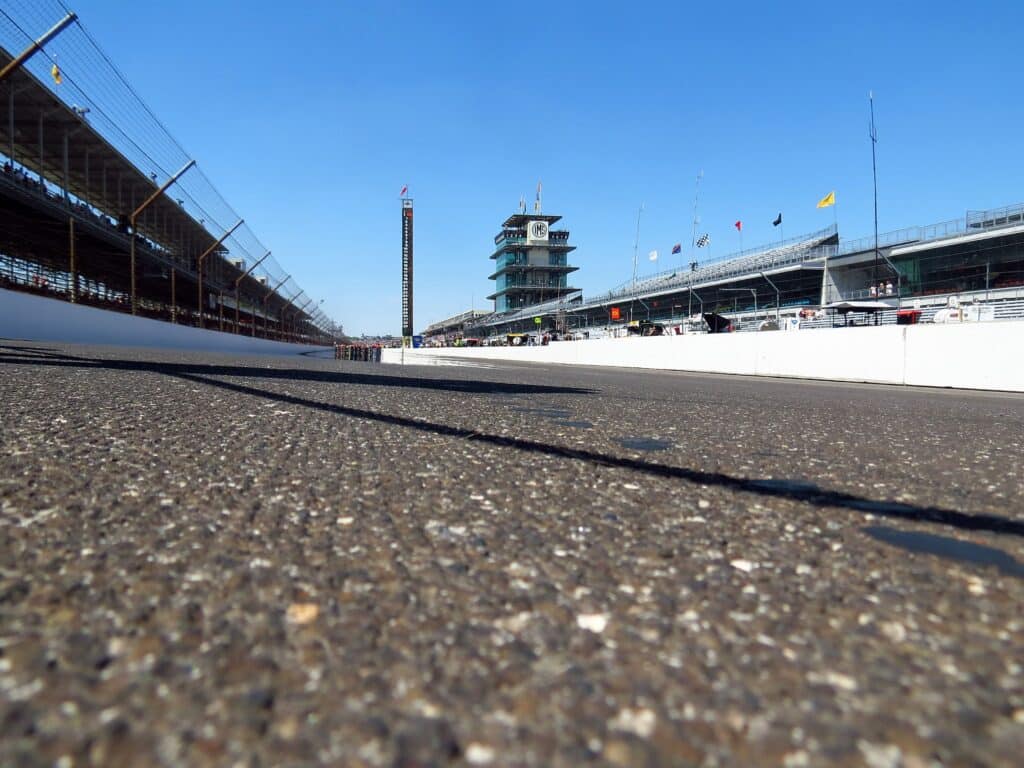
Heritage Research Group’s Bill Pine discusses his career in the skilled trades, the science behind asphalt performance and our long-standing role preserving the racing surface at Indianapolis Motor Speedway.
Long before the green flag waves at the Indianapolis 500, thousands of hours of work have already gone into preparing Indianapolis Motor Speedway.
Every inch of the facility matters. None more critical than the track’s surface.
At speeds approaching 240 miles per hour, the asphalt of the Speedway is more than pavement. It becomes a critical part of performance, safety and competition. It must withstand weather, heat, stress and the physical forces of cars cornering at banking angles that would be impossible on an ordinary road. And it has to do all of that while delivering consistency at the highest level of motorsports.
Bill Pine understands this better than almost anyone.
The Quality Control Director of Asphalt Technology at Heritage Research Group, Bill has spent his career at the intersection of asphalt science and real-world application. His work represents one of the most demanding proving grounds in materials research: a racing surface where the margin for error is effectively zero.
“We do everything we can to help preserve the pavement to buy them [Indianapolis Motor Speedway] life and also keep it safe for the drivers that drive at the insane speeds they do around this track.”
That responsibility, preserving a surface that has to perform under the most unforgiving conditions in motorsports, captures the central challenge of the work. It’s not enough to engineer a surface that performs under race conditions. It has to last through Indiana winters, heat cycles, maintenance traffic and the relentless passage of time, and then perform again when it matters most.
Bill recently sat down with The Line podcast, a series dedicated to highlighting careers and opportunities in the skilled trades, to talk about that work. Recorded at Indianapolis Motor Speedway as part of The Line‘s Brickyard Series, the conversation explores his career journey, the role of Heritage Research Group within The Heritage Group portfolio, and the long-standing relationship between THG, Heritage Construction + Materials and one of the most iconic venues in the world.
The history behind that relationship matters.
Since 1909, Indianapolis Motor Speedway has served as a proving ground for innovation. Long before modern testing facilities existed, the track was designed as a place to push materials, engineering and technology to their absolute limits under real-world conditions. That spirit remains central to the Speedway today.
It’s the same mindset that drives the research and development work at Heritage Research Group.
Through the combined expertise of HRG and Heritage Construction + Materials companies including Milestone Contractors and Asphalt Materials, Inc., teams study, test and refine asphalt technologies designed to improve durability, safety and long-term performance. What begins in HRG’s research and development environment is validated in the field, where conditions like those at IMS provide the ultimate test.
That collaboration has been continuous. When the Speedway’s surface was repaved in 2004, the engineering challenge wasn’t just laying new asphalt. Drivers were accustomed to a diamond-ground surface that provided exceptional grip, and any replacement mix had to meet a standard defined by years of driver expectation and competitive performance. The decision to use a stone-matrix asphalt mix, with its high stone-on-stone contact and structural durability, came from exactly the kind of research-informed problem solving that defines HRG’s work.
But the work didn’t stop there. As the number of events and races at IMS has grown over the years, placing greater stress on the surface, the partnership has evolved alongside it. Smoothness and friction testing, real-time preservation strategies, targeted repairs and ongoing maintenance are all part of a relationship built on trust and a shared commitment to getting it right, year after year.
For Bill, that continuity is the measure of the work. Not the technical specifications or the testing data, but the confidence of the people who depend on it at 240 miles per hour.
That’s part of what makes careers in the skilled trades and applied sciences so meaningful. They are built on a foundation of expertise and practical knowledge that translates directly into outcomes people depend on, often without knowing it. The person who engineered the road you drove to work this morning. The team that tested the materials in the bridge you crossed. The researcher who solved a problem on a racetrack that will eventually improve the highway surface in your city.
At The Heritage Group, those opportunities exist across a broad portfolio of businesses, from construction and infrastructure to environmental services, sustainability and specialty chemicals. They require people who are curious, technically rigorous and committed to work that lasts.
Bill Pine’s career is a demonstration of what that looks like over time. What began as a path through asphalt research and engineering has grown into decades of contribution to some of the most demanding and visible applications in the industry. Including the surface beneath the Indianapolis 500.
The same curiosity that drives asphalt research at IMS is at work across The Heritage Group’s portfolio, in environmental remediation, battery recycling, specialty chemicals and beyond. For anyone considering a career in the trades, science or engineering, that’s the reminder embedded in his story. The work is specific, skilled and serious. And sometimes, it puts you at the center of one of the most iconic sporting events in the world.
Enjoy Bill Pine’s episode on The Line podcast: